


Conveyor Pulley RFQ Checklist: What Suppliers Need to Quote Accurately
Posted at June 10, 2026Accurate conveyor pulley pricing depends on one thing above all else: clear, complete input data.
At CPS, we regularly receive RFQs and RFPs for pulleys across mining, quarrying, and port conveyor systems. When the right information is provided up front, we can quote faster, reduce design iterations, and ensure the pulley supplied is fit‑for‑purpose across its service life.
This guide outlines exactly what information CPS requires to produce an accurate quote or proposal, whether a General Assembly (GA) drawing is available or not.
Overview: Why Complete Information Matters
The more complete your initial submission, the faster you receive a quote you can use, which means fewer clarification rounds, shorter lead times, and a final design that matches your site conditions the first time.
When a client contacts CPS for a pulley quote or proposal, there are several critical data points we need to:
- Validate pulley suitability
- Determine shaft, shell, and bearing requirements
- Check fatigue and service‑life factors
- Provide an accurate cost and delivery estimate
CPS has supplied pulley and idler systems to major Australian mining operations including BHP South Flank, where over 14,000 frames were delivered to schedule across a 26km conveyor system.
In many RFQs, the client supplies a GA drawing, allowing us to quote quickly and efficiently.
For new conveyor systems or complex applications, a GA may not yet exist, in which case additional technical input is required before pricing can be finalised.
RFQ Checklist (GA Drawing Provided)
When a client GA drawing is supplied, grease and paint specifications are often omitted. These are not required for quotation and can be finalised during project scoping. All the below details should also be contained, and those that aren’t will require later confirmation.
Pulley Details (Required)
- Pulley type (Drive / Tail / Bend / Counterweight / Snub)
- Quantity
- Pulley face width (mm)
- Pulley shell diameter over steel (mm)
- Shell thickness (mm)
- Shell material (AS250 / AS350)
- Crowned profile (Y/N)
- Speed flags fitted (Y/N)
- Lagging type (Plain Rubber, Rubber Backed Ceramic, Polyurethane, Direct Bond Ceramic)
- Lagging pattern/percent ceramic coverage
- Lagging thickness (mm)
- If Plain Rubber or Rubber Backed Ceramic Lagging – Adhesion method (Cold bond/Hot Vulcanised)
Bearings, Shaft & Assembly
- Bearing housing designation
- Bearing designation
- Seal type / designation
- Bearing housing centres (mm)
- End disc centres (mm)
- End disc thickness (mm)
- End disc material (AS250 / AS350)
- Shaft material (K1045 / 4140)
- Shaft diameter at midpoint (mm)
- Overall shaft length (mm)
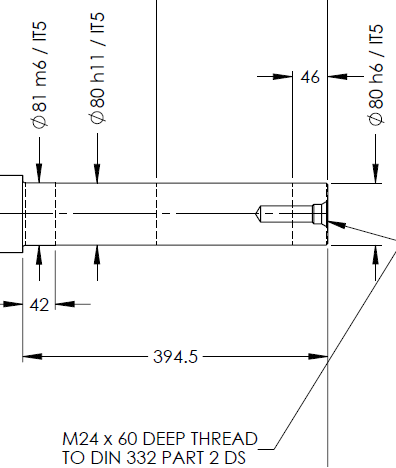
- Shaft ends (threads / centres)
- Shaft locking element manufacturer
- Shaft locking element designation
- Shaft locking element journal diameter (mm)
- Shaft locking element housing required (Y/N)
Lubrication (Optional for RFQ)
- Preferred grease manufacturer
- Preferred grease type
If a client drawing is not available, these dimensions are required for CPS to prepare our own GA drawing following order placement.
Additional Requirements – Drive Pulleys
Drive pulleys require additional detail for the drive journal, particularly where couplings or gearboxes are involved.
For single‑diameter drive journals, please supply:
- Coupling keyway
- Coupling journal diameter
- Coupling journal length
Some drive arrangements require multiple journal diameters, steps, and radii, which should be clearly defined to avoid misalignment, stress concentration, or coupling issues.
RFP Checklist (GA Drawing Not Provided)
When CPS is asked to design the pulley and determine the majority of dimensions, the minimum information required is:
Conveyor Load Data
-
-
- Belt width (mm)
- Belt speed (m/s)
- T1 / T2 – operating (kN)
- T1 / T2 – maximum (kN)
- Number of starts > 900 per year (Y/N)
- Belt entry angle (deg)
- Belt wrap angle (deg)
-
If your conveyor design is still in progress and some of these values are not yet confirmed, submit what you have. Our engineers can work with preliminary load data to begin the design conversation and identify what additional inputs will be needed before final pricing.
Additional Information for Drive Pulleys
-
-
- Bearing to gearbox centre of gravity distance
- Overhung load
-
Basic Pulley Geometry
-
-
- Pulley face width
- Pulley shell diameter
- Bearing housing centres
-
These inputs allow CPS to develop a compliant pulley design aligned with AS 1403 and applicable Australian Standards for fatigue life expectations, and site operating conditions.
Final Note: More Information = Faster, Better Outcomes
Pulley design involves far more than basic geometry. Load cycles, start frequency, fatigue life, shaft deflection, and lagging performance all influence the final design.
The more information provided up front, the faster CPS can deliver:
- A technically compliant solution
- An accurate, defensible quotation
- Reduced design rework
- Shorter lead times
Once we receive your submission, one of our pulley engineers will review it and come back to you within [X] business days for a standard RFQ with GA drawing provided, or [X] business days for an RFP requiring CPS design input. If anything is unclear or missing, we will contact you directly before proceeding.
If you’re planning a new conveyor or upgrading an existing system, click below to request a quote, and include as much of the checklist above as possible to help us deliver the right solution, first time.